People we’ve helped exonerate
Paul Shane Garrett

Paul Shane Garrett was fully exonerated on August 18, 2021, the culmination of a twenty-year fight to clear his name from a crime he did not commit.

Case history
On June 15, 2000, the body of Velma Tharpe, a 30-year-old sex worker, was found in a Nashville alley. She had been strangled. A rape kit and swabs taken from her body collected biological evidence at the scene. More than a year later, detectives focused their attention on Paul Shane Garrett, a 27-year-old tow truck operator who lived nearby.
Over four days of interrogation, detectives lied to Shane repeatedly, falsely claiming that witnesses had placed him at the scene, and that his DNA had been found on the victim. They secretly recorded a conversation with his wife after promising him it would not be taped. They administered a polygraph and told him he had failed. The charts from that examination later disappeared from the police file. Additionally Detective Roy Dunaway, in sworn testimony at a preliminary hearing, described detailed confessions that simply did not exist on the recordings; admissions Shane never made, statements he never gave, and a choking demonstration on his wife that the tape showed never happened.
In September 2001, DNA testing excluded Shane as the source of the biological evidence collected from Tharpe. It made no difference. He remained in custody for nearly two more years, unable to post bond, exhausted, and facing a murder charge that carried a potential life sentence. On June 20, 2003, on the advice of counsel, Shane pled guilty to voluntary manslaughter. The rape charge was dropped. He was sentenced to 15 years in prison.
Three months later, the DNA profile from the crime scene was matched through the FBI’s CODIS database to another man. A letter notifying Dunaway and the District Attorney’s Office was sent in December 2004.
No action was taken. Shane remained in prison.
It cannot be overstated how Mr. Garrett's now-debunked 'confession' has shaped the narrative and direction of his case. Now, in his own words and through filings by both Mr. Garrett and the State, the Court is hearing clearly for the first time Mr. Garrett's voice and the facts associated with the case.
Angelita Blackshear Dalton Judge
Building the case for innocence
Shane was released on parole in December 2011, but his conviction stood, and his name remained tied to a murder he didn’t commit. TIP took on his case, working alongside the Davidson County District Attorney’s Conviction Review Unit.
The groundwork for that work had been laid years earlier by two Nashville cold case detectives who refused to let the case die. In 2011, detectives began reviewing unsolved murders of sex workers in Nashville and came across the letter that had been sitting in the file since 2004, the letter notifying the original detective and the DA’s office of the DNA match to another person.
The detectives went back through the interrogation recordings. What they found confirmed what Shane had said all along: Dunaway had testified falsely at the preliminary hearing. The admissions Dunaway described under oath, the detailed confession, the choking gesture on Shane’s wife, were not on the tapes. The detectives brought their findings to the Nashville Police Chief, then to the DA’s office. An assistant DA reviewed the evidence and wrote plainly: “I do not believe that we can permit Garrett’s conviction to stand.” She concluded that the interrogation recordings were not confessions, they were the product of highly suggestive techniques in which detectives fed Shane information and he struggled to make sense of what they were telling him. “I believe that Garrett is not guilty of this murder,” she wrote. “Garrett deserves to be released immediately with no conditions and to have his record clear.”
That recommendation went up the chain, but nothing happened. Shane was eventually granted parole, but the conviction wasn’t vacated, the charge wasn’t dismissed, and years continued to pass.
By the time TIP became involved, Dunaway had long since been reassigned to patrol after testifying falsely in another case. His partner Bernard had resigned years earlier after being accused of fabricating evidence in a different homicide. Their credibility had collapsed, but Shane’s conviction had outlasted both of their careers.
In October 2020, Detective Mike Roland brought the case to the DA’s Conviction Review Unit again. In May 2021, another person was charged with Tharpe’s murder.
Exoneration
In July 2021, the parties formally requested that Shane’s conviction be vacated.
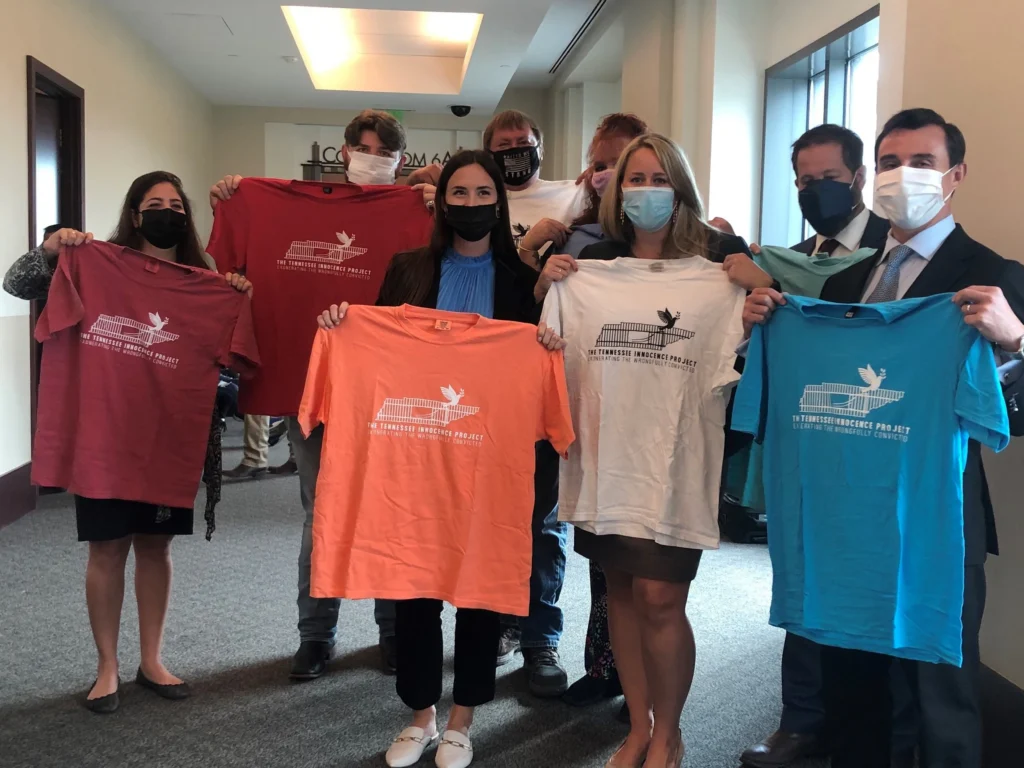
On August 2, 2021, Judge Angelita Blackshear Dalton vacated Paul’s conviction. On August 18, 2021, the charge was dismissed.
Shane was tearful speaking to the press outside the courthouse.
“I didn’t get to watch my kids grow up. I wasn’t in their life. It affected my ability to get a job. It affected my ability to trust anyone, because I learned there are bad and good detectives. It changed everything.”
Paul Shane Garrett’s case was TIP’s first exoneration, and it set the standard for everything that followed.
“It is our honor to have represented Mr. Garrett and achieve our first exoneration since forming the Tennessee Innocence Project as a state-wide non-profit in 2019,” shared founding Board President, Stephen Ross Johnson, a criminal defense attorney and partner at Ritchie, Davies, Johnson & Stovall, P.C. “This is a huge victory, not only for Mr. Garrett, but for our State as we work to ensure justice for all means all.”
See more exonerees

Links & Resources
We are fighting every day to correct these injustices
—but we can’t do it alone.